
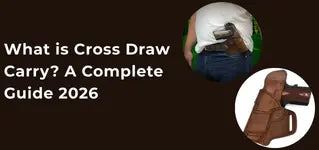

Times change, and so do the methods of carrying firearms. As personal defense philosophy evolves and takes on new meaning, we can also observe shifts in carriers.
One carry style that is quite contentious and continues to spark debates is the cross-draw carry. Yes, it is a carry method that attracts polarizing opinions, and you will soon get to know why!
Sounds fascinating? Join us as we explore the A to Z of cross-draw carry and understand if it is right for you.
Cross Draw Carry - An Explanation
A cross-draw carry is a type of concealed carry method wherein your firearm is holstered on the opposite side of your dominant hand. So, if you are right-handed, then you wear the holster on your left side and vice versa.
The holster usually sits around the 9-10 o’clock position for right-handers and tilts forward. The draw stroke moves the hand across the torso to access the grip.
The method provides easy access, especially while being seated, enhanced comfort, and more seamless concealment options. But, as you might have already seen this coming, cross-draw carry also has a few cons; slower draw time, and safety risks are a few of them.
The ‘When’ Of Cross Draw Carry - A Brief History
If you love history, then this section will definitely pique your interest. Cross-draw carry has quite a long and fascinating past. Many cavalry soldiers, horse riders, and frontiersmen of the 19th century favored the cross-draw holsters, as they enabled easier, swifter access while they were seated on horseback.
Then, detectives and plainclothed officers began resorting to it in the mid-20th century. Cross draw carry gained popularity among drivers, pilots, and outdoor workers who needed accessibility while seated or wearing bulky gear.
Nowadays, the method is not super mainstream but relevant and quite favored in certain specific contexts.
Reasons To Choose Cross-Draw Carry
To know whether or not the cross-draw carry style is for you, it is essential to understand the pros and cons.
Easier Access While You Sit
The biggest advantage and cited merit of cross-draw carry is its ease of access when sitting. Individuals who spend a chunk of their time driving, working at desks, or operating machinery find cross-drawing more comfortable and easy to access than other positions.
Compatibility With Outdoor Gear
Hikers, anglers, and hunters often wear backpacks, chest straps, or hip belts. Many carry positions interfere with the gear, but the cross draw does it less. It also helps -
- Keeping the firearm accessible even when the backpack is on
- Move freely and comfortably in tight or crowded spaces
Reduced Hip & Lower Back Pressure
Carrying weight directly on the dominant-side hip can cause discomfort or fatigue for a lot of people. Cross draw distributes the firearm’s weight to the non-dominant side, which reduces strain on the hips and is especially beneficial with larger firearms. The setup also keeps your strong-side arm free for natural movement.
Different Concealment Options
Cross-draw carry also provides a platter of concealment options, as the firearm follows your body’s natural lines. The setup works well with a variety of clothing styles, such as winter jackets, professional outfits, loose, casual wear, sports coats, etc.
Natural Motion For Certain Movements
Lastly, another viable merit of cross-draw carry is that some users report its reaching motion across the body to be more natural, especially while wearing heavy outer garments.
In a nutshell, cross draw is not a universally acceptable carry method, but it provides advantages for certain body types and certain motions.
Reasons Not To Choose Cross-Draw Carry
Despite its unique merits, cross-draw carries certain challenges.
1. Concealment Challenges
You can find it harder to conceal your firearm under light clothing, as it is positioned towards the front of your body. Certain movements, such as bending or reaching, can increase printing.
2. Safety Considerations
Cross-draw carry creates safety issues and concerns if not paired with adequate and proper equipment and training. A 2017 study reveals that 38% of beginners trying the cross-draw method pointed their firearm at bystanders during drills; this is three times higher than strong-side carry. Hence, instructors and experts usually recommend it for specific use cases.
3. Slower Access While You Stand
Cross-draw carry is less efficient for some people when standing and moving. This is subjective and depends on body type, mechanics, and clothing.
4. Steeper Learning Curve
Cross-draw carry has a steeper learning curve, demanding more practice to master. It mandates precise movements, including proper hip rotation, a 45-degree elbow angle, and an immediate clearance with your weak hand. For instance, the average weekly practice reps for cross draw is 50, and that for strong-side carry is 25.
So, only about 14% of USCCA-certified instructors recommend cross-draw as a primary carry method and advise its usage for specific situations, like operating in vehicles.
5. Not Universally Accepted
Lastly, some shooting ranges, training facilities, and workplaces restrict cross-draw owing to safety measures and policies.
Who is Cross-Draw Carry For?
As we have already mentioned, cross-draw is recommended as the primary carry method for very few individuals. In fact, it is a context-specific style that is usually favored in unique situations.
Some people who might benefit from cross-draw carry are -
- Long-distance drivers
- Vehicle operators
- Pilots
- Sportsmen and outdoor workers
- People with limited shoulder or hip mobility
- People with extended seated time
Key Takeaways
Long story short, cross-draw is a controversial style of carrying firearms. This is mostly because of the safety concerns it raises. The method is, undoubtedly, more difficult to ace, and is fitting only in certain circumstances. If you are someone who sits for extended time periods, is a hunter, angler, etc, then it is essential to learn and practice cross-draw carry and make sure that you are absolutely perfect at it. The right holster plays a critical role in making cross-draw carry safer and more comfortable.
Shop our premium Cross Draw Holster designed for stability and accessibility.



Leave a comment (all fields required)