



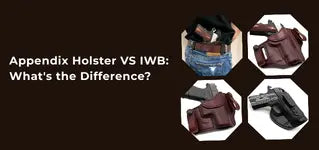

Concealed carry is an art. Doing it right is incredibly personal and equally strategic. If you are new to the entire shazam, then let’s get one thing straight - your holster is as crucial as your firearm when it comes to concealed carry.
And, appendix holsters and IWB (Inside-the-Waistband) holsters are two of the most popular options. Both provide unique concealment, comfort, and retention advantages, but what is perfect for you depends on several unique factors.
Join us as we help settle the debate over appendix holster vs. IWB, ensuring you make the right choice.
A Guide To IWB Holsters
An IWB holster must be worn inside the waistband of your pants. Concealment, consistency, and retention are a few of the reasons people favour IWB holsters.
You can wear an IWB holster in different positions around the waist, such as behind the hip, directly on the hip, slightly forward of the hip, and so on. Such flexibility means that the one holster works across different carry positions, depending on your comfort and body type.
What makes an IWB holster distinct and unique, and may be right for you? Let’s find out!
- Designed for concealment under everyday clothing
- Often secured with clips, loops, or soft attachments
- Available in materials like leather, Kydex, or hybrids
- Can accommodate different waist positions
A Guide To Appendix Holsters
An appendix holster is a specific subcategory of an IWB holster. Yes, they belong to the same overarching unit. The term appendix implies its placement near the front of your body, usually around the 1 o’clock position for right-handed users.
They are especially built for front-of-body placements with the shape, angle, and attachment system optimized for such a position.
So, you can say that all appendix holsters are IWB holsters, but not all IWB holsters are appendix holsters. Quite interesting, isn’t it?
But this is not the only fascinating aspect of an appendix holster; it has other features, as well.
These include -
- It is intended for front-waist positioning
- Comes in compact and minimal designs
- Available in materials like leather, Kydex, or hybrids
The front-waist position is what adds a specialized trait to appendix holsters and sets them apart from the more generalized IWB holsters.
Appendix Holsters V/S IWB Holsters - Know The Difference
You did not click on this blog to simply know the basics of an appendix holster and an IWB holster. Yes, we know you want to get into the differences. Without further ado, let’s begin.
| Appendix Holster | IWB Holster | |
| Placement (Where the holster is worn) | Specifically designed to be worn on your body’s front | Can be positioned anywhere along the waistband |
| Design Philosophy | Designed for specialization | Designed for versatility, as you can wear them across different carry positions |
| Comfort | Appendix holsters are often discussed in relation to seated activities, such as sitting in a chair or a vehicle | Usually worn toward the side or back, and may feel less intrusive when standing or walking |
| Concealment | Conceals at the front, where clothing drapes differently | Traditional IWB holsters conceal along your hip’s natural line |
| Accessibility & Movement | Built around front-access positioning | Built for broader adaptability and movement |
In a nutshell, it’s essential to realize that there is no such difference in comfort between the two. Neither option is universally ‘more comfortable,’ as it varies from person to person, and on other factors, like fit, body shape, etc.
Similarly, the difference in concealment is also subjective, as some people find front-of-body concealment to be more appropriate, while others prefer side placement.
Pros & Cons - The Real Battleground
Definition? Check! Differences? Check! Now, let’s quickly glance through the pros and cons of appendix holsters vs. IWB holsters.
Pros of an IWB holster
- It is flexible
- Commonly available and found almost everywhere
- Adaptable to a lot of different body types.
Cons of an IWB holster
- Not optimized for a specific placement
- Not specialized enough for some people
- Comfort may vary based on the placement
Pros of an appendix holster
- Designed specifically for front carry
- Compact and streamlined
- Consistent positioning
Cons of an appendix holster
- Limited to just one placement
- Not universally comfortable for all users
What Will Work For You?
Firstly, there is no one-size-fits-all answer to this debate. Neither option is universally better than the other. The right choice depends on how the holster integrates with your body type, wardrobe, and daily routine.
But, as a thumb rule, if you value versatility and want a holster that can adapt to different positions, go for an IWB holster. Likewise, if you spend long hours standing or walking, an IWB will work just fine for you, as it distributes pressure evenly along your waist.
But, if you prefer a dedicated front-position design with a streamlined profile, then an appendix holster makes much better sense. And, in case you wear a lot of fitted shirts, lighter cover garments, or shorter jackets, an appendix holster will be the best bet.
Final Thoughts
Long story short, appendix holsters and IWB holsters are different, but there is not a sea of difference. People compare them as if they are opposites, but in reality, one is a subset of the other. The key is to understand how each holster is designed and what problems it aims to solve. This ensures that you appreciate the diversity and art of concealed carry without reducing the conversation to simple ‘better or worse,’ or appendix holsters v/s IWB holsters debates.



Leave a comment (all fields required)