



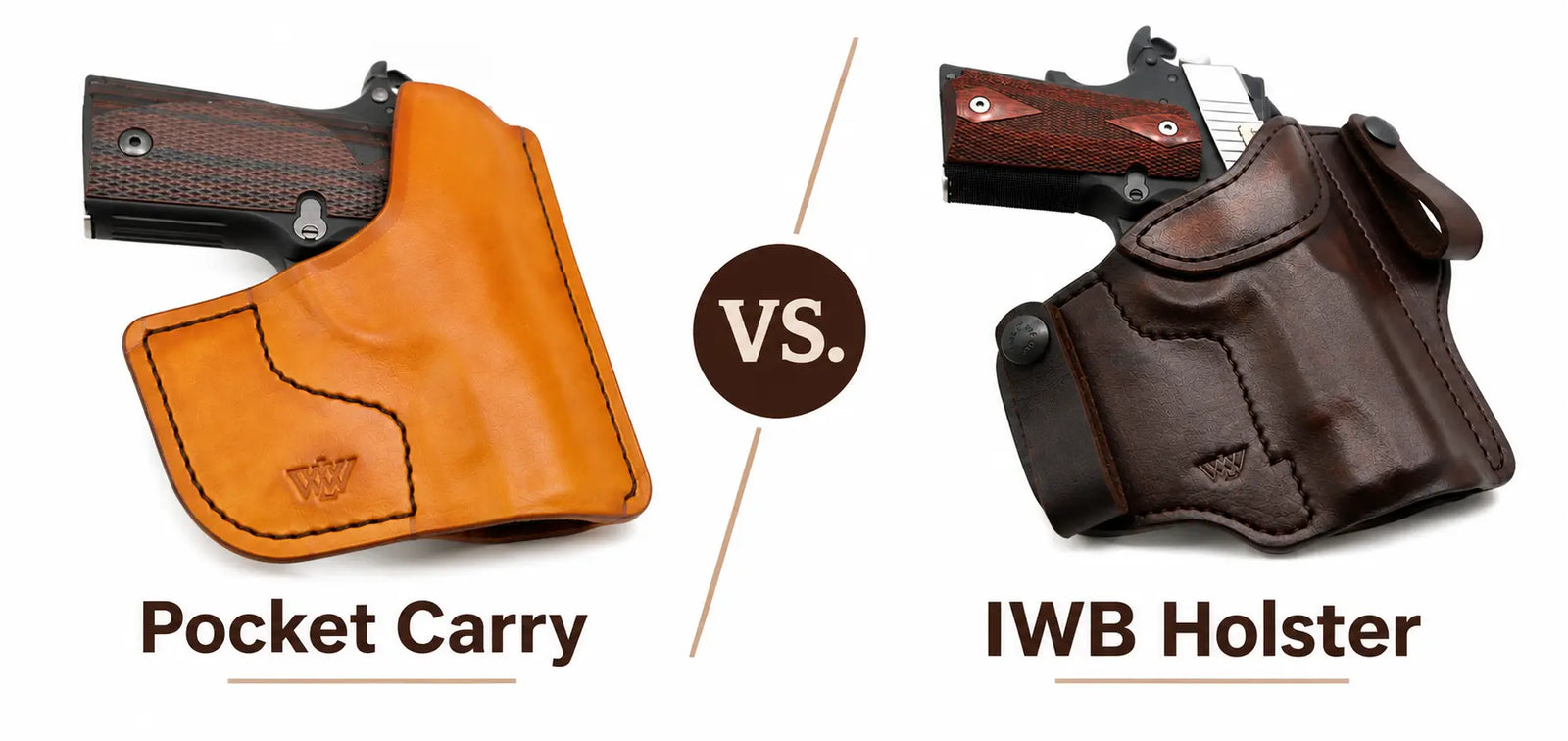

The choice between pocket carry and an inside-the-waistband holster ultimately depends on your firearm size, your clothing choices, your daily life, your comfort level, and the concealed carry laws in your area. None of them is better than the other. Pocket carry can work when paired with suitable guns and clothing that fits, while waistband holsters offer flexibility to carry a wider variety of firearms.
Safety should always be the first priority while carrying a gun, as stated by NSSF. The best approach is to choose a location that secures the firearm in the holster, keeping it safe from accidental discharge.
Pocket Carry vs. IWB at a Glance

| Feature | Pocket Carry | IWB Carry |
| Typical firearm size | It is a small and compact firearm | IWB accommodates a wider range, from compact up to larger firearms. |
| Gear required | It is suitable for a pocket holster | IWB holster comes with a suitable belt |
| Clothing flexibility | It works best with appropriate pockets | It goes well with everyday clothing |
| Comfort | These are quite convenient for small firearms | It is quite dependent on the type of holster and clothing |
| Concealment | Quite convenient with proper clothing | Normally provides strong concealment |
| Capacity options | Firearm size determines the capacity | Multiple firearm-size choices |
| Sitting/driving | It is applicable in certain situations | Comfort varies by carry position and setup |
| Main consideration | It is pocket and firearm compatible | Total comfort with holster fit and belt support |
What Is Pocket Carry?
Pocket Carry refers to a concealed-carry option in which a firearm is carried in a designated pocket holster designed for the purpose. The holster is designed to keep a weapon positioned properly, as well as to secure the gun's trigger.
How Pocket Carry Works
The setup for pocket carry consists of a compact gun and a holster made particularly for this method of carrying a weapon. It is critical that the holster remains in the proper position and does not slide around.
One of the most important safety concerns with pocket carry is that the gun should not just be placed in the pocket. Furthermore, you need to ensure the pocket is appropriate. If it is too shallow, narrow, loose, or crowded, it will not work efficiently.
Best Gun Sizes for Pocket Carry
Pocket carry is usually suited to compact, lightweight firearms, specifically designed for ease of everyday carry. This is not suitable for larger firearms because of discomfort, visibility issues, or practical size problems.
What Is an IWB Holster?
An IWB holster is a holster that carries a firearm in the waistband of pants or a skirt. The holster is placed between the wearer’s body and clothing, with the waistband helping secure its position.
IWB holsters come in various sizes to offer the flexibility that pocket carry cannot. However, comfort depends on the quality of the design, gun size, clothing, and body type.
How IWB Carry Works
Typically, the IWB setup uses a holster installed firmly on the pants belt or waistband. An ideal holster should fit the firearm well and cover the trigger well enough to provide a minimum level of protection.
Common IWB Carry Positions
IWB carrying may be set in varying places around the waist. Different placements are suitable depending on comfort, concealment, safety, and training recommendations.
Pocket Carry vs. IWB: Key Differences
Comfort
While comfort is subjective, pocket carry may offer moderate comfort when combined with small firearms and appropriate clothing. However, weapons in pockets may become noticeable because of their weight if the user has to walk for extended periods of time.
IWB carry provides different weight distribution. While IWB carry may be much more comfortable for some individuals, others may find it uncomfortable due to pain caused by the waistband.
Concealment
Pocket carry is a concealed method of carrying as the gun stays in the pocket. However, the gun's outline or weight can be visible in certain cases because of the clothing and pocket design.
IWB carry places the gun under clothing, making it possible to conceal it well as long as the carry arrangement is correct. The fit of the clothes, body movements, and size of the gun affect how concealed the arrangement is.
Draw Speed
Speed of access is often presented in the Pocket Carry vs IWB debate as a key aspect. However, access can depend on many factors, such as clothing, firearm, holster, body position, or the situation, and what works for one person may feel uncomfortable for another.
On top of that, you should keep in mind that concealed carry is essential. Thus, safety, equipment reliability, training, and statutory compliance should be treated as far more important issues that require attention.
Safety & Trigger Protection
When reviewing any concealed carry approach, the need to emphasize safety is probably the most compelling reason to do so.
A good holster protects the trigger region and is specific to the firearm. This is even more pertinent for a pocket carry, as pockets can contain anything else extremely easily.
Just casual pocket carrying without a proper holster leads to unnecessary danger, as does using an IWB holster that isn’t right for your gun and doesn’t secure the trigger properly.
Gun Size & Capacity
Firearm size has important implications for the availability of certain methods.
Pocket carry is usually limited to firearms of smaller size since larger firearms may not fit comfortably into the pocket. Small firearms may also vary with respect to their capability due to their size.
The IWB carry method is more versatile compared to the pocket carry method as IWB accommodates a larger size range of firearms. However, this does not ensure that any firearm can be used with any IWB setup.
Comfort in Hot Weather & Different Clothing
Attire can greatly affect the comfort level of concealed carry.
In warmer weather, lightweight clothing can make a firearm more apparent or uncomfortable for some carry permit holders.
It is sometimes easier to justify pocket carry when clothing has pockets, but you must still account for the firearm's weight and size.
Loosely worn clothing makes IWB concealment easier, while clothing with no pockets at all could render pocket carry ineffective.
Cost & Gear Needed
For pocket carry, you may not need many items, including a compatible firearm and an appropriate pocket holster. On the other hand, the prices of good quality products may vary a lot.
IWB carry usually requires a holster and, depending on the setup, a suitable belt and a supportive waistband. At the same time, additional equipment may increase the total expenses.
Price has to be one of the factors to consider, but there are also other important aspects.
Accessibility
While Sitting & Driving Everyday, use affects how different carry methods feel. Effects of prolonged sitting or being in a vehicle can also change the feeling of pocket carry and IWB carry.
Pocket carry also helps avoid some of the discomforts of sitting, but pocket access and comfort still depend on clothing and the type of vehicle. IWB carry's comfort depends on the user's body type and the type of clothing they wear.
Which Carry Method Is Right for You?
There is no single solution to the comparison of pocket carry versus IWB carry.
Pocket carry is ideal for someone who wears clothing appropriate for the method, appreciates the minimalistic approach to carrying, and prefers a compact configuration. IWB carry is better suited for an individual who needs more options for the size of a weapon they carry and has practical apparel and belt arrangement.
Be sure to consider the following when making your decision:
- The size and weight of a firearm
- The compatibility of the holster and triggering mechanisms
- Your wardrobe
- Your time spent in a seated position
- Your ability to carry the configuration comfortably
- The safety and handling of the weapon
- The applicable regulations in your jurisdiction
- The proper way to carry is one you can undertake legally and with ease.
Why Leather Makes a Difference for Both Carry Methods
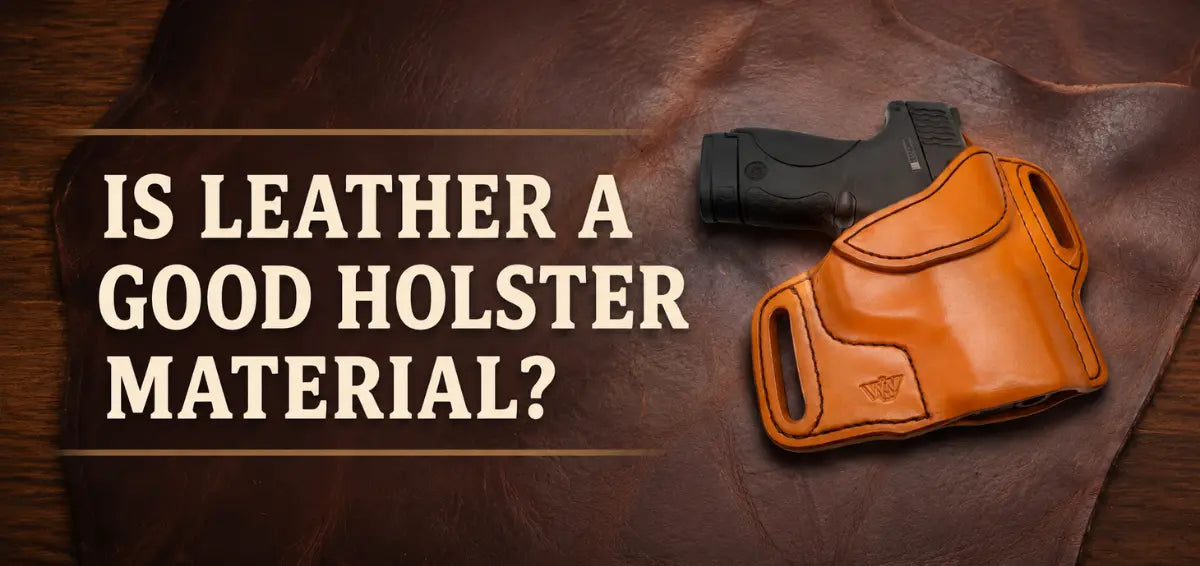
Holsters made from leather have been used for many years because of their durability, comfort, and the long tradition of quality leather craftsmanship. A well-made leather holster can greatly improve fit and appearance.
While leather has advantages as a material, the right holster choice depends not on the material itself but on its characteristics and performance.
Moreover, leather can be more demanding in terms of maintenance when compared to synthetics. For example, exposure to moisture, heat, or excessive wear and tear can lead to the deterioration of leather.
When considering a leather holster, customers should choose a holster made for the gun that they are going to carry rather than pick leather simply because of its looks.
Final Thoughts
The discussion about Pocket Carry and IWB is really about more than discussing which method is better than the other; it is about the combination of gun, holstering, clothing, comfort, and safety.
Pocket carry has the advantage of being an easy way for a person to carry as long as it is the right gun, pocket, and holster. IWB provides full versatility that suits different guns and clothes.
In any case, safety first! Use an appropriate holster with trigger protection; make sure to follow laws; be sure to have hands-on training.
Frequently Asked Questions
Is pocket carry actually slower than IWB carry?
The answer is not one-size-fits-all. Access depends on clothing, gear, body position, and particular situations. Instead of just concentrating on speed, responsible concealed carry is about using secure equipment, protecting the trigger, training, and following the law.
Can you pocket carry a full-size handgun?
Usually, a full-sized handgun does not lend itself to being carried in one’s pocket due to its size and weight. Carrying a gun in one’s pocket is typically reserved for smaller firearms and involves using a pocket holster designed for the entire pocket gun combination.
Do I need a belt for pocket carry?
While a belt is not typically necessary to utilize a pocket-carry system, the pocket must also be appropriate for the specific firearm and holster. Using loose or inappropriate pockets may cause the pocket carry method to become a poor choice.
Is pocket carry considered "concealed carry" everywhere?
Not really. Gun laws actually vary from country to country, and from state to state, and even from local authority to local authority. Definitions, permit requirements, places where carrying guns is prohibited, and rules regarding gun storage can differ from one jurisdiction to another.
Can I switch between pocket and IWB carry depending on the day?
People have different carry options based on their clothes and what they do every day. If you choose to follow this method, make sure your chosen carry method complies with the set safety requirements, such as the compatibility of the chosen method with the firearm, trigger safety, and legal requirements.
Which is more comfortable for sitting all day, pocket or IWB?
It is all about the person carrying it and the type of equipment. While pocket carrying can remove pressure from the waist area, IWB comfort can vary significantly depending on the type of firearm, holster, clothing, and the person carrying it. What feels comfortable to one may not be so for someone else.



Leave a comment (all fields required)