



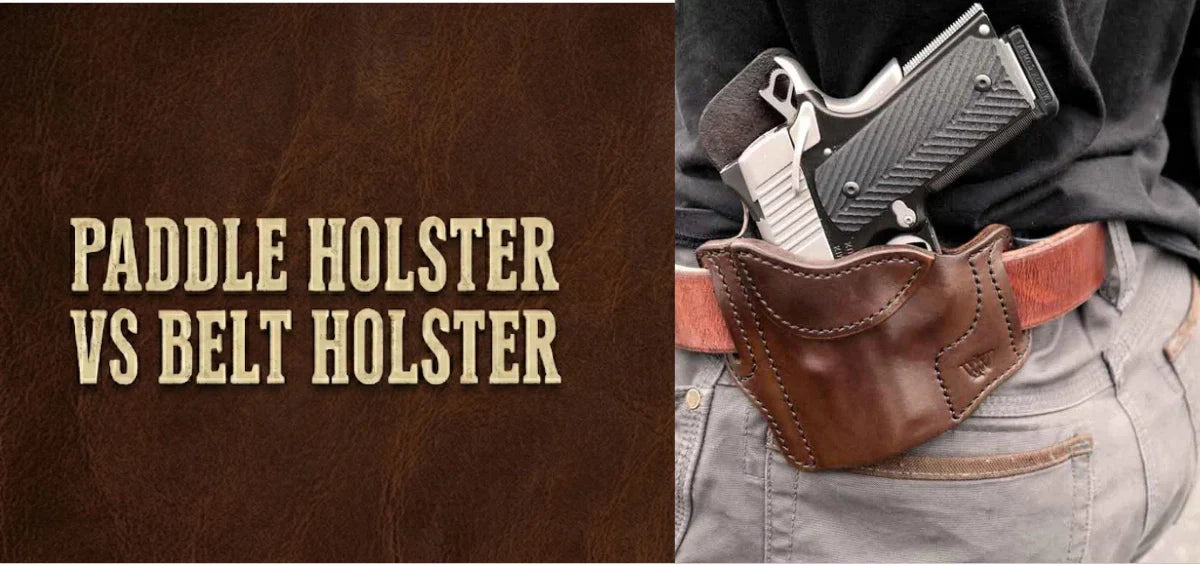

When selecting a holster, it’s critical to choose one that best fits your needs since this will impact comfort level, ease of access, and security of your weapon. In addition to a very large number of styles of holsters available to shooters, two of the more common ones are the paddle holster and the belt holster.
While both types of holsters may appear similar on the outside, they have multiple differences internally in how they attach to your body as well as how they perform under various conditions. The difference can greatly influence how securely the holster holds your weapon, allowing you to draw it quickly or keep it comfortable for long periods.
This guide defines the differences between paddle and belt holsters.
Understanding Paddle Holsters and Belt Holsters
Although the paddle holster and the belt holster support outside-the-waistband use, the differences in their attachment systems determine their features.
The paddle holster relies on a wide, paddle-shaped component attached to the body outside the waistband; however, the actual paddle goes under the waistband, providing pressure-based fixation. This means you can easily put this holster on and take it off without removing your belt.
As for the belt holster, it relies on loops or holes where your belt is inserted to fix the holster tightly. This makes it much more convenient to use this type of holster.
Key Differences Between Paddle Holster and Belt Holster
The biggest differences between a paddle holster and a belt holster are how each fits against your body, as well as how well they fit your other gear.
Generally speaking, paddle holsters are intended to be put on very quickly. You can either put them on or take them off in a matter of seconds; therefore, they provide you with the flexibility to quickly either practice at the range or transition into/out of restricted areas.
Belt holsters, on the other hand, tend to take a little longer to attach (because you have to thread the holster through your belt), but once attached, they stay put and don't shift as easily.
Another difference is the positioning. Paddle holsters allow repositioning without removing your belt, whereas with a belt holster, they are in a fixed position, which leads to forming consistent drawing techniques and developing the proper muscle memory to do so. Overall, each type of OWB holster accomplishes these tasks adequately, but there are certainly pros and cons associated with them that could significantly affect your everyday life.
Advantages of Paddle Holsters and Belt Holsters
Each type of holster offers its own advantages, depending on whether the user wants maximum mobility and flexibility or a stable option that will last all day.
First of all, it should be noted that paddle holsters are designed for quick attachment and removal, since they do not require a person to take their belt off. As a result, they are perfectly suitable for people who need to remove the holster frequently, and this feature allows users to easily adjust the holster's position. Such a flexible solution may be necessary during range practice sessions.
At the same time, belt holsters are distinguished by greater convenience and durability, as they cannot shift out of position during movement or activity because they are attached to the belt itself. Besides, such holsters lie closer to the body, which positively influences the process of drawing a gun and improves shooting accuracy. Over time, it leads to the development of muscle memory.
To summarize, the main differences between the two options are the ease of use of a paddle holster and the increased durability of a belt holster.
Limitations of Paddle Holsters and Belt Holsters
However, there are certain limitations associated with each that need to be taken into account as well.
For example, while wearing the paddle holsters, there is likely to be some movement because friction holds the gun in place. It may cause instability when one is actively moving or running. What is more, such a holster will probably be a bit farther from the body, so it won't be very good at concealment if you want to wear fitted clothes. It may also be easier to get it out if needed, which raises concerns about security.
As for the belt holster, its main problem is the inconvenience of having to remove the belt and put it back when necessary. Moreover, its rigidity does not allow for adjustment of the position after mounting. You may experience some discomfort if the holster is not put on properly.
Thus, it becomes evident that the first type sacrifices stability for comfort and convenience, while the second sacrifices flexibility for security.
Which One Should You Choose
It is up to you which type of holster you want - a paddle holster vs a belt holster.
If you prefer convenience and accessibility, you will be interested in using a paddle holster. This type of holster is perfect for shooting practice and travel, and frequent removal from the holster is not an issue.
On the other hand, if you prefer a sense of control and stability will choose the belt holster because it ensures security and fosters confidence.
To summarize, paddle holsters mean fast accessibility and simplicity, whereas belt holsters imply control.
Conclusion
The purpose of paddle and belt holsters is to securely hold your firearm and provide easy access to it. A paddle holster provides an easily accessible, mobile option for carrying your firearm, while a belt holster provides stability during draw.
Due to the differences between these two holster types, there is no “one size fits all” solution. The right choice for you will depend on how you carry your firearm, how often you use it, and your personal comfort level with it. When you wear a paddle holster, you can quickly draw your firearm, while a belt holster gives you the confidence that your firearm is secured and easily accessible when needed.
Knowing the differences between paddle and belt holsters will help you choose the best holster for your needs. The better your holster works with your habitual use, the greater your comfort and confidence will be in your everyday carry.



Leave a comment (all fields required)